

Beachcombing on Block Island
The beaches beyond Southwest Point on Block Island are wild and often deserted. Trees, boulders and the detritus of the shipping industry wash ashore along the ocean-facing side of the island, while people remain largely absent.
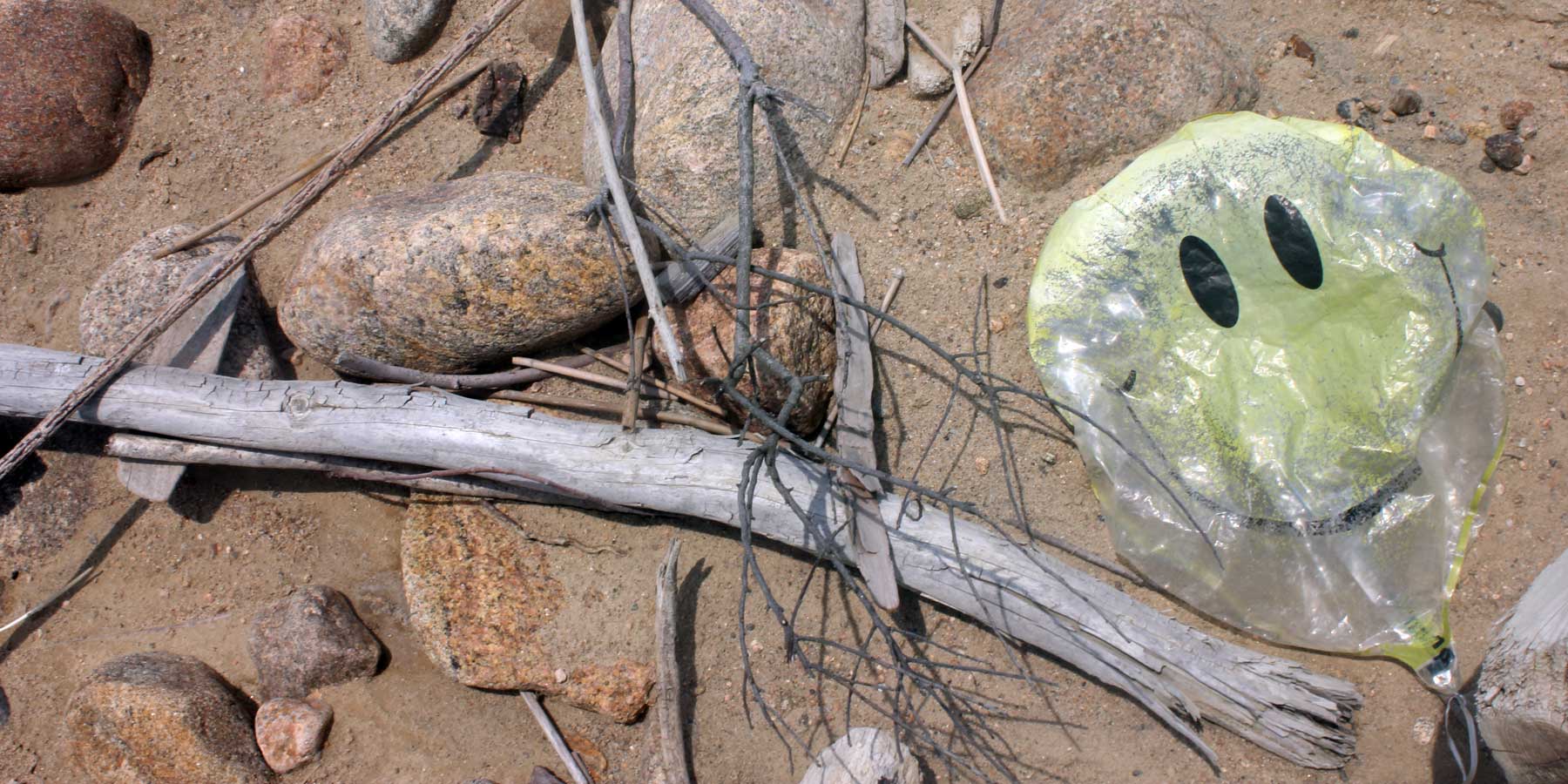
For years I have collected cellophane balloons washed up on this remote Rhode Island beach. Tangled in seaweed, wrapped around rocks or half buried in sand, they began as curious finds and gradually became something more resonant and troubling.
GYRE, The piece I created for Reuse, Reinvent Reimagine started with the beachcombing ; the process of acquiring junk, trash, stuff to be sorted later.Walking along a beach, a place I call home at a time in my life where that term represents many places many times. a work constructed entirely from balloons I have recovered from a remote beach off the east coast of America, will be shown as part of Reuse, Reinvent, Reimagine an exhibition of ten Scotland based artists which is on at Gallery 23 as part of the Edinburgh Fringe from Aug 10th – 28th.
GYRE
These recovered balloons became the basis for GYRE, a body of work constructed from found marine plastic gathered over many years. Tied to rituals of celebration and commemoration, balloons become strangely sinister once discarded: relics of consumer culture transformed by the sea.
The project explores our emotional attachment to objects and the turbulence of memory associated with them. I am interested in how objects move between intimacy and waste — treasured one moment, forgotten the next — and what this process of collective forgetting reveals about our relationship with the environment.
Alongside the installation, I also created transfer drawings using imagery and text taken from the recovered balloons, inspired by techniques pioneered by Robert Rauschenberg. Fragmented slogans and faded graphics become traces of memory, consumption and loss.
Objects and memory
As anthropologist Daniel Miller writes:
“objects are important not because they are evident and physically constrain or enable but often precisely because we do not ‘see’ them.”
Perhaps the real power of these objects lies in how easily they disappear into the background of everyday life — until they return to us again on the tide.
Work from GYRE has been exhibited at Gallery 23 during the Edinburgh Fringe and later developed further for exhibition at the Edinburgh College of Art Tent Gallery. The project continues to evolve through new installation work exploring memory, materiality and environmental loss.